The relevant normative measures and articles in the national and international press are published in this section.

Pubblichiamo in questa sezione i provvedimenti normativi e gli articoli che appaiono sulla stampa nazionale e internazionale.

Italian Episcopal Conference: suggestions on some measures to deal with the Covid emergency

Link: https://www.chiesacattolica.it/segreteria-generale-cei-suggerimenti-su-alcune-misure-per-fronteggiare-lemergenza-covid/

Cari Confratelli,

abbiamo da poco celebrato il Mistero del Natale, contemplando la gloria del Verbo fatto carne. In queste settimane abbiamo avuto anche modo di gustare la bellezza e la fatica del “camminare insieme”, rintracciando nelle nostre comunità la stessa ricerca che mosse i pastori e i Magi verso Betlemme.

Purtroppo, la pandemia non accenna a finire e proprio in questi giorni il numero dei contagi continua a salire. Si tratta senza dubbio di una grande prova per tutti: malati e sofferenti, medici e operatori sanitari, anziani e minori, poveri, famiglie. E anche per i sacerdoti che, nonostante tutto, sono sempre prossimi al Popolo di Dio; per i catechisti, gli educatori e gli operatori pastorali, veri maestri e testimoni.

Consci della situazione generale, raccomandiamo a tutti prudenza, senso di responsabilità e rispetto delle indicazioni utili a contenere l’epidemia. Al riguardo, sono ormai noti gli aggiornamenti normativi introdotti dagli ultimi tre decreti legge (DL 24 dicembre 2021, n. 221; DL 30 dicembre 2021, n. 229; DL 7 gennaio 2022, n.1). Con vicinanza fraterna richiamiamo di seguito alcuni punti, condividendo consigli e suggerimenti.

Celebrazioni liturgiche. Non è richiesto il Green Pass, ma si continua a osservare quanto previsto dal Protocollo CEI-Governo del 7 maggio 2020, integrato con le successive indicazioni del Comitato Tecnico-Scientifico: mascherine, distanziamento tra i banchi, niente scambio della pace con la stretta di mano, acquasantiere vuote… Occorre rispettare accuratamente quanto previsto, in particolar modo: siano tenute scrupolosamente le distanze prescritte; sia messo a disposizione il gel igienizzante; siano igienizzate tutte le superfici (panche, sedie, maniglie…) dopo ogni celebrazione. Circa le mascherine, il Protocollo non specifica la tipologia, se chirurgica o FFP2; certamente quest’ultima ha un elevato potere filtrante e viene raccomandata, come peraltro le autorità stanno ribadendo in questi giorni.

Catechismo. Le disposizioni circa il tracciamento scolastico prevedono, in alcuni casi, la “sorveglianza con testing”: a seguito di contatto stretto in ambito scolastico, studenti e docenti non vengono posti immediatamente in quarantena ma devono sottoporsi a tampone il prima possibile e nuovamente cinque giorni dopo. Le indicazioni del Ministero della Salute sconsigliano la partecipazione ad attività extrascolastiche durante tale periodo, tra il primo e il secondo tampone. Pertanto, chi è sottoposto a “sorveglianza con testing” non potrà partecipare al catechismo, pur risultando negativo al primo test, fino all’esito negativo del secondo test da effettuarsi cinque giorni dopo il primo. Per gli operatori (catechisti, animatori ed educatori…) è vivamente raccomandato l’utilizzo della mascherina FFP2. Anche ai partecipanti alla catechesi tale tipologia di mascherina sia raccomandata. Può essere opportuno che le parrocchie tengano alcune mascherine FFP2 di scorta da far utilizzare a chi ne fosse sprovvisto o l’abbia rotta, sporca o eccessivamente usurata.

Mascherine FFP2. L’uso di mascherine FFP2 è obbligatorio per Legge per alcune situazioni. Si consiglia l’utilizzo anche per tutte le attività organizzate da enti ecclesiastici.

Obbligo vaccinale per gli over 50. Ricordiamo che, a partire dal giorno 8 gennaio 2022, è stato introdotto l’obbligo vaccinale per tutti coloro che hanno compiuto 50 anni.
La vaccinazione può essere omessa o differita in caso di accertato pericolo per la salute, in relazione a specifiche condizioni cliniche documentate, attestate dal medico di medicina generale dell’assistito o dal medico vaccinatore.
Dal 1° febbraio 2022 saranno in vigore le sanzioni pecuniarie per coloro che non vi adempiono e dal 15 febbraio 2022 sarà necessario il Green Pass rafforzato (cfr allegato) per l’accesso ai luoghi di lavoro per i lavoratori pubblici e privati con 50 anni di età.

Obbligo vaccinale per il personale universitario. Dal 1° febbraio 2022 è stato introdotto l’obbligo vaccinale per tutto il personale universitario, senza limiti di età. Ne consegue che il personale delle Facoltà Teologiche e degli Istituti di Scienze Religiose nonché i docenti dei corsi curriculari nei Seminari sono tenuti a possedere il Green Pass rafforzato a partire dal 1° febbraio 2022. Le modalità di controllo sono le stesse fino ad ora attuate per il Green Pass base.

A tutti un fraterno augurio di buon anno.

LA SEGRETERIA GENERALE
DELLA CONFERENZA EPISCOPALE ITALIANA
Protestant Federation of France, “New clarifications for the sanitary requirements for worship concerning lockdown “press release 30 October 2020

Consignes sanitaires pour les cultes : précisions 2ème communiqué

Suite à un rendez-vous avec le bureau central des cultes au Ministère de l’Intérieur ce vendredi 30 octobre 2020, voici quelques précisions concernant cette nouvelle période de confinement :

– Si les lieux de culte peuvent rester ouverts pour le recueillement, il n’est pas possible de célébrer des offices religieux recevant du public, à compter du lundi 2 novembre 2020 jusqu’au 1er décembre 2020.

– A titre exceptionnel, il est possible de célébrer des cultes ce dernier week-end d’octobre dans le respect strict et rigoureux des mesures sanitaires déjà mises en place. Les fidèles devront se prémunir d’une attestation de déplacement à laquelle ils peuvent ajouter la mention manuscrite : « participation exceptionnelle aux célébrations cultuelles du week-end de la Toussaint 30 octobre et 1er novembre selon la tolérance accordée par l’Etat »

– Les quatre aumôneries (AESMS, Prisons, Armées, Aéroports) peuvent poursuivre leurs actions par le fait des aumôniers agréés de la Fédération protestante de France (FPF). Ils doivent demander au niveau national de chaque aumônerie un justificatif de déplacement professionnel couvrant toute la période de confinement.

– Cultes en vidéo dans les temples : Il est possible à partir du 2 novembre d’organiser dans les temples des célébrations en nombre de célébrants réduit qui permettront à l’office liturgique de se dérouler pour proposer aux fidèles un enregistrement des cultes de qualité en vidéo ; nombre de personne maximum fixé à 20 célébrants (officiants, chorale, musiciens, techniciens et personnel local)

La FPF invite toutes les Eglises et communautés du protestantisme français à suivre ces recommandations et à les communiquer largement dans toutes les paroisses et communautés dans leurs réseaux et auprès des fidèles.

La Fédération protestante de France se tient toujours à votre disposition :

Contact/infos :

Pasteur Georges Michel , Secrétaire Général

Tel. 06 85 23 37 28 – Mail. georges.michel@federationprotestante.org

Médias/presse :

Aude Millet-Lopez, Responsable de la communication

Tel. 06 73 39 55 98 – Mail. aude.millet-lopez@federationprotestante.org

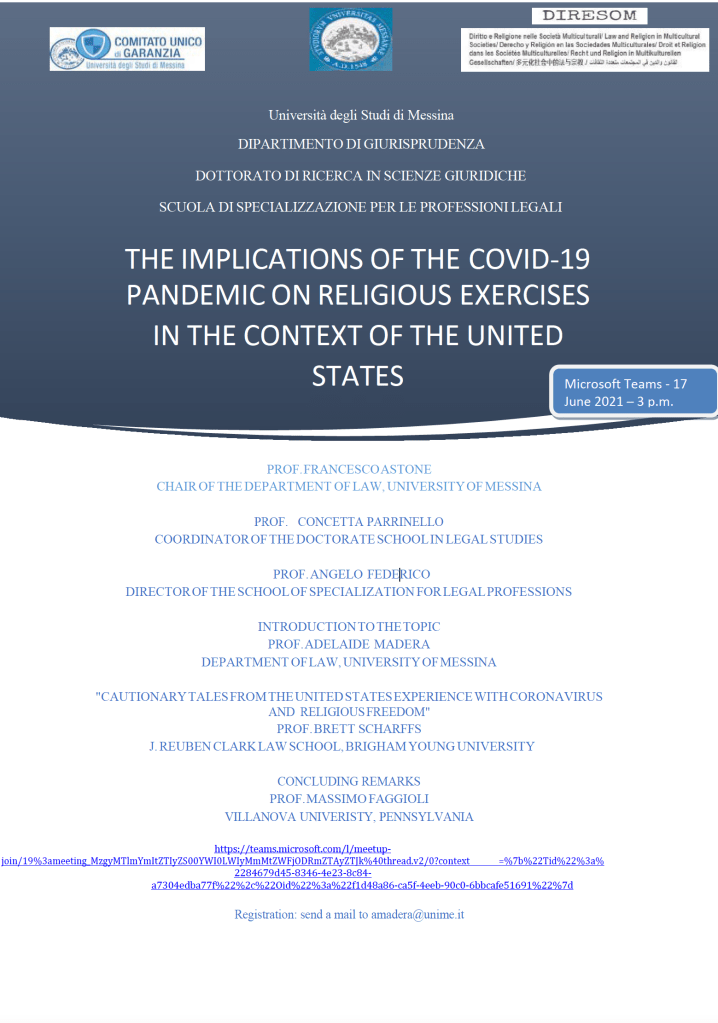
THE IMPLICATIONS OF THE COVID-19 PANDEMIC ON RELIGIOUS EXERCISES IN THE CONTEXT OF THE UNITED STATES 

“The Crisis of Religious Freedom in the Age of COVID-19 Pandemic”

“COVID-19 Vaccines v. Conscientious Objections in the Workplace”, by Adelaide Madera (Canopy Forum)

Click here

Le juge des référés du Conseil d’État rejette la demande d’adaptation du couvre-feu pendant la semaine de Pâques

Women in the COVID-19 Crisis: Disproportionately Affected and Protagonists of Regeneration

https://www.humandevelopment.va/en/news/2021/women-in-the-covid-19-crisis-read-the-new-transversal-newsletter.html

In the midst of the pandemic, discriminatory social norms compounded by other disadvantages (e.g.
poverty, race, ethnicity, and religion) have increased the vulnerability of countless women across the
globe. Despite this, many women have shown great resilience in balancing work and family life, and
coping with the threat and reality of infection

COVID-19 Vaccines: Resources for Church Leaders

Dear Brothers and Sisters

News of the successful development of effective vaccines against COVID-19 has brought much needed
hope, yet the pandemic is far from over. As cases rise and the virus mutates, the pandemic continues to
bring suffering, isolation, financial hardship and death, disproportionately affecting the most vulnerable
among us. Yet the crisis has also “revived the sense that we are a global community, all in the same boat,
where one person’s problems are the problems of all” (Encyclical Fratelli Tutti [FT], 32). “With our gaze
fixed on Jesus (cf. Heb 12:2) and with the certainty that His love is operative through the community of His
disciples, we must act all together, in the hope of generating something different and better” (General
Audience, 26 August 2020).
In times of coronavirus and “great human and socio-economic viruses,” the Church is called to walk with
others on a “journey of healing,” bringing “light in the midst of darkness, […] justice in the midst of so
many outrages, […] joy in the midst of so much pain, […] healing and salvation in the midst of sickness and
death, […] tenderness in the midst of hatred […] to ‘viralize’ love and to ‘globalize’ hope in the light of
faith” (General Audience, 30 September 2020). We must “rediscover once for all that we need one
another, and that in this way our human family can experience a rebirth, with all its faces, all its hands and
all its voices” (Cf. FT, 35).
A first step in our journey toward a more just, inclusive and equitable world is making COVID-19 vaccines
available and accessible to all, as outlined in the December 2019 paper, Vaccine for all: 20 points for a
fairer and healthier world, published by the Vatican COVID-19 Commission and the Pontifical Academy for
Life.
The following resources are designed to support parish priests and staff in diocesan offices and health
and social service agencies. You will find information about the COVID-19 vaccine for varied audiences,
resources to support the preparation of homilies, relevant quotes from Pope Francis, links to useful
information, and short messages for websites, parish bulletins or other media. A Family Guide to the
Coronavirus (COVID-19) is designed to help local communities and to counter misinformation.
As we look towards a better future, we are reminded “how vulnerable and interconnected everyone is”
(General Audience, 12 August 2020) and that “to build a healthy, inclusive, just and peaceful society we
must do so on the rock of the common good” (General Audience, 9 September 2020). Ensuring access to
vaccines for all should be considered an act of love of our neighbour and part of our moral responsibility.
We hope this material can be helpful for use in parishes, clinics, schools, social service agencies, and
beyond. If you have any questions or suggestions for how local churches can get involved, please contact
vcc@humandevelopment.va.
Cabina di Regia of the Vatican COVID-19 Commission
H. E. Card. Peter K. A. Turkson
Prefect
Dear Brothers and Sisters,
Mons. Bruno Marie Duffé
Secretary
Rev. Fr. Augusto Zampini
Adjunct Secretary

Decree of the President of the Vatican City Commission on Public Health Emergency on Vaccination Obligation of Employees